Stack Rush is a block-stacking game that is completely different from traditional puzzle games. This game has a very brain-teasing board rotation mechanism.
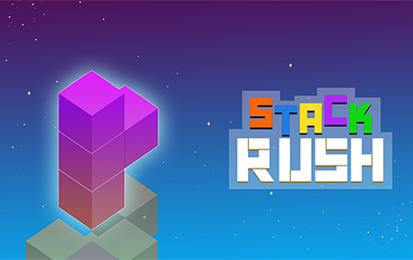
In Stack Rush, you will play on a board of 9 squares. The blocks will fall slowly from above, allowing you to observe and make reasonable decisions. Each block has a diverse shape, requiring you to calculate to arrange it scientifically.
Instead of moving the blocks, the Stack Rush mechanism allows you to rotate the entire board. This is the point that makes a big difference: you have to rotate the board to the right direction, then choose the falling position to create the most perfect connection.
Stack Rush and Block Blast both revolve around smart block arrangement, but each game creates a very unique puzzle style, attracting players with completely different strategies. Stack Rush not only challenges the ability to observe but also requires thinking to continuously rotate the structure. Each block placement decision can affect the entire game that follows. The slow falling rhythm makes you feel comfortable, but later the rush and pressure of rotating the board makes the game more addictive.
Here are the important elements in how to play Stack Rush that you need to master to control the block board most effectively:
During the process of playing Stack Rush, the block height will increase. Your task is to create full planes to eliminate the stacked block layers. Each time you clear a plane, the board will become lower, and you will have more space to continue to master the game.
Always remember that if the board reaches the height limit, the game will end. Therefore, a reasonable strategy is to prioritize eliminating blocks as soon as possible, avoiding letting them pile up too high.
The special point of Stack Rush is that you do not move the blocks but instead rotate the entire board.
Rotate the board left, right, or 180 degrees to bring the empty position to the right direction. Use the mouse drag operation. You drag the board to the direction you want, the board will rotate in the direction you drag.
When the board is finished rotating, the block will fall into its natural position in the direction you choose. The falling point will be shown in a different color on the board. Use that to determine the falling point more accurately.